Work Text:
Romilda Vane is still interested. She owled again today. Third time.
He had typed the message to Hermione at half eleven in the morning and spent the rest of the day finding reasons to check his phone.
Around five, when he was just stopping by the daycare to pick up Teddy, it buzzed.
At least you'd get laid quite a lot. He could hear the exact flatness in her voice, the precision of it, the thing she did when something was actually funny but she wanted to appear as though she was reserving judgement.
He typed back: The vapid conversation might get old somewhere around year two. Year three at outside.
Then he headed inside to talk to Mrs. Smuthers about Ted and his propensity to hide in the coat closet when it was time for practicing letters, and how the payments for the summer term were to be directed to him and not Andromeda despite Andi's protests, thank you very much.
His phone buzzed when he was merging onto the M25. He chanced a look at it when he stopped at the traffic lights.
Depends on how long her enthusiasm for your cock could sustain your interest.
The light was still red. He dictated. I feel quite neutral about that [comma] actually [period].
Three dots appeared. Disappeared. Reappeared.
Then I'm guessing you've gotten laid recently.
He blinked. The light turned green.
Damn it. She wasn't wrong.
He drove through Islington letting his mind unspool over the last few weeks. The brown stone of the row houses slid by while Teddy kept up a constant narration of the drive, interspersed with his thoughts on the Tyrannosaurus Rex his friend Gavin had procured and a dissertation on why Muggle chocolate frosting was superior to the wizard variety.
The indicator clicked an even rhythm.
It had been three nights with a Muggle girl he'd met at the Tesco on Queensway. The sex was decent. The conversation was— wanting. He had resolved to let it be one of his periodic mistakes — and he'd managed that well enough, until now, when he found himself hoping Hermione wouldn't ask.
She would just go quiet in that way she did, and then ask him if he was doing alright. If he was happy. And he would say yes, and she would say, Alright then.
And she’d change the subject and that would be that.
When he got back to Grimmauld he put the phone on the hall table and looped Teddy's knapsack over its hook.
"Oi! Get back here and hang up your coat, young man!" he called toward the stairs.
Some exasperated grumbling filtered down, followed by the sound of Teddy's exaggerated stomp.
Harry arched an eyebrow and pointed to the coat and trainers.
Teddy grinned impishly and picked up the trainers, casting them carelessly under his knapsack. "I'm going out to the garden!" he called as he clambered back down the stairs.
"Okay," Harry said faintly, though he might as well have said nothing for all the attention Teddy was paying.
He looked down at the phone and scrubbed a hand over his face.
He decided to be the one to change the subject this time.
Regular shift or double today? he typed.
When he sat down to dinner with Teddy, she still hadn't written back.
Four hours later, he was lying on his back in the dark with Teddy finally, blessedly asleep in the next room. The child had worn himself completely through clambering on the new playset in the garden and dropped like a stone at six-thirty.
He had told himself he would just go to bed — treat this as a regular Tuesday evening instead of trying to stay up until after Hermione's shift ended. He should get some rest.
And yet here he was — midnight and hoping to call Chicago in the next half hour.
The Ministry had amended the law that afternoon. The fifth draft had been leaked and the Prophet had published it in the evening edition in a font designed to incite panic.
Harry had read the first draft in February, folded it in thirds, and put it in the drawer with the gas bill and a drawing Teddy had made of what he described as a dragon but which was, in Harry's professional assessment, more likely a very aggressive chicken.
He had not thought about the law again until three weeks later when Hermione texted him at two in the morning — her evening, his small hours — and said, God, I hope you have your phone on silent. Have you read the new draft? The enforcement clauses are worse.
He had not read the new draft. He read it then, at two-fifteen, sitting on the edge of his bed with the phone very bright in his hands, and she was right.
I'm up now, he wrote back. Don't apologise. He knew she would anyhow. They're trying to rebuild the registry.
Sorry I woke you. It's by the back door, isn't it? she replied — which was what he'd thought but hadn't written yet, the end of his sentence arriving in her hands before he'd finished forming it — and he sat with that for a moment in the dark before he typed back: Exactly.
That was the end of February. By March the offers had started, which he had not told her about in any systematic way but which had accumulated in their conversation the way most things did: sideways, between other things, in the gaps.
First, Parvati had owled, and then cornered him in the bakery where he bought an almond croissant every Sunday. He told Hermione about it in a long voice call that evening.
"I mean, Parvati and Lavender have been a couple since eighth year," he said. "Apparently I was meant to just — I don't know. Be useful."
Hermione hummed. "She must be trying to solve the requirements of the law without actually having to marry someone she doesn't want to marry."
"And I play into it how, exactly?"
"You're her friend, Harry. And a good bloke. I'd imagine she thought you'd manage the whole thing respectfully."
Harry snorted. "You mean when it came to doing the impregnating, I'd be willing to find a turkey baster?"
Now it was her turn to laugh. "Where did you leave it with her?"
"I told her to call Ron and Draco."
"Oh, brilliant," she said, and he could hear the grin in it.
Ron and Draco had been married for almost two years by then, after a ceremony that Draco had arranged with the precision of a man who wanted nobody to have reason to criticise a single detail. The marriage had apparently been in progress, in various senses, since eighth year, though Harry had only caught up to it when Neville and Pansy married. He had watched Ron and Draco bantering across a table and had the belated realisation somewhere around his second glass of champagne that he may have been the last person in the room to understand what he'd been seeing for a while now.
Ron had caught his expression and grinned with the cheerfulness of someone who had no intention of explaining himself, and Draco had leant around Ron's shoulder and looked at Harry with the particular expression he reserved for Harry's occasional failures of perception. We know, Draco had said. It's fine. You'll get there.
Hermione and Ginny, watching from beside him, burst out laughing.
When the two married a year later, both he and Hermione were at Ron's side. Best mates, Ron had said at the pub when he asked them. And we've always sort of terrified Malfoy as a group, yeah?
He still remembered how she beamed at him when he referenced Weasley is Our King in his toast.
It was the last time he'd seen her in person.
He set the phone on his chest and looked at the ceiling. The house was very quiet. In the kitchen, the tap was dripping at its usual rate, which he had been meaning to fix since March, and the faint scrape of the cat next door carried through the garden wall at intervals. He picked the phone back up.
There was an unread message from Ginny.
It wasn't new.
Ron had mentioned it last weekend. "You know she'd be happy to do it," he said, popping a handful of crisps into his mouth.
Harry hadn't looked away from the screen above the bar, where Manchester United were down a goal and the whole left side of the pub had opinions about it. He felt Ron's eyes on him. "I do," he said finally.
Ron shrugged. "You'll figure it out, mate."
When he'd told Hermione about it later she was quiet for a moment, and then: "Maybe it's worth considering—"
"No," he said, not unkindly. "That's not — it wouldn't be fair to her. It's not where I am." He stopped. Out in the garden something rustled through the hedge. "I think she might be hoping the law gives us a reason to try again."
Hermione was quiet for a long moment. "I think," she said carefully, "that's probably right."
"I can't do it to her." He looked at the ceiling. The light fitting needed cleaning; it had needed cleaning since January. "She deserves someone who's actually in it."
He heard Hermione breathe out through her nose. "I'm proud of you, Harry," she said — the way she said true things, without any dressing on them — and Harry held the phone and looked at the ceiling and let it sit.
He didn’t say anything back.
He must have dozed off. The phone buzzed and the notification light blinked once, twice, the rhythm of it like a heartbeat on the bedside table. He watched it without moving for longer than he should have.
He picked it up.
If you're still awake, I can chat.
He held it for a moment just waiting. He had that briefing with Robards and Sanderson tomorrow. He should go back to sleep, turn off the lamp, get a proper rest.
He pressed the call button.
"Hi." Her voice was soft. "I can't believe you're still up."
"I can't either," he said. To his surprise his voice was rough with sleep.
"Oh, I woke you, didn't I?" she said, and he could hear the apology, see the way her brows would draw together, the way her frown would sit lower on the left side of her mouth.
"It's fine," he said. "I wanted to hear your voice."
He heard the little intake of breath. "Oh." A pause. "Are you all right, Harry?"
"It's nothing like that," he said, sitting up now. "It's just — the latest draft of the law was published. Some things have changed."
"Tell me?" she said, interrupting.
"I'm getting there," he said fondly. He heard the small sounds of her moving in the background and found himself grinning at what he imagined she was doing — shrugging off her Healer robes, kicking off the trainers she wore, rifling through the post and putting the kettle on.
"The big change is that same-sex couples don't have to divorce and remarry. They can have surrogate donorships with other couples."
Hermione scoffed. "Well, that's big of them. So at least some people don't have to worry about rape."
Harry grimaced. "Yeah. Incrementally better is still better, though."
"No, you're right," she said, voice softening. "It is better." He heard the tap of a spoon against a mug. "What else?"
He sighed. "I wish I knew a better way to say it, but — you're not exempt."
Silence met him.
"What does that mean, 'I'm not exempt'?" she said finally.
"They're specifically targeting expats who fall within the ages covered by the law," Harry said. "If you come back, you'll be arrested and either have to comply or face expulsion — wand broken and everything."
"Oh, for fuck's sake!" Hermione spat. "Well, that's an easy choice. I won't be back."
Harry stilled. She was still talking — he could hear it, the gathering momentum of her outrage — but he'd stopped following the words.
He had known this would happen. The wizarding world had pushed and pushed and grabbed and grabbed and taken from her until she couldn't breathe. She'd come bursting into Grimmauld one afternoon three years earlier and told him she'd found a programme in Chicago and was going to finish her Mastery there. There, she explained, no one gave a shit whether she was a war hero, and on the other side, no one gave a shit whether she was Muggle-born. She paced back and forth, hands waving, explaining why this would be the best possible scenario and how it might actually put her a bit closer to her parents in Sydney — not that it mattered — and that she just needed to get the fuck out of Britain, and when she finally took a breath he pulled her into a hug. He waited until he felt the tension go out of her, felt her sag against him. Then he said, "How can I help?" And she burst into tears.
But her plan had worked. She thrived in Chicago, making friends and exploring the city and becoming known as a brilliant Healer — not despite her natural disadvantages — but simply because she was, and they kept up through mobiles and Skype and went through life in parallel, more or less, across six time zones.
Except he missed her.
He missed her when she wasn't there to get drunk with him after he ended things with Ginny, right before their second anniversary. She wasn't beside him to pick up Ted the first time Andromeda spent the night in hospital. And though she'd come back for Ron and Draco's wedding, she wasn't there to elbow him when he deliberately wound both of them up at one of their fancy dress parties by wearing an old tee and jeans and claiming to be Bob Dylan — she was the only person in his life who would have understood why that was funny.
He just missed her — and he’d got so used to it that he no longer considered its weight.
But now he would go on missing her.
He felt the heat prick behind his eyes and pressed them shut, which was absurd, and he rubbed the back of his neck and said nothing.
The silence must have reached her. She stopped mid-rant and when her voice came, it was small. "Harry?"
"Yeah," he said, swallowing. "I'm here."
"I'm sorry," she said. "You know none of that is directed at you."
He nodded but stayed quiet.
"You know—" She paused and took a breath.
"You know if there was one reason I would come back—"
She paused again. Then: "—it would be you."
His throat felt dry. "Yeah, I know, Hermione."
Another silence stretched across the Atlantic.
"Do you?" she finally asked, even softer now.
"Yeah," he said, and even as he said it a faint flicker told him he was missing something.
She did not say anything for a long moment.
Then a sigh. "How's Teddy?"
He accepted the turn without comment. "Turning his hair blue. Andromeda says he does it when he's overstimulated and doesn't know it yet. The baker in the high street thought there was something genuinely wrong and I had to do fifteen minutes of managing before she'd let us leave."
"Poor woman," Hermione said. "Poor Teddy. How did he take it?"
"He got a free Chelsea bun out of it, so his view is broadly positive."
She laughed, and he felt his shoulders drop a half-inch.
"Come for his birthday," he said. He hadn't planned it. He heard it after he'd said it. "A boy only turns five once."
Silence. Not the deciding silence. The other kind, which he'd never quite been able to name — the one that felt like she was somewhere in the middle of something.
"That's very soon," she said.
"End of April, yes."
"That's two weeks away."
"I'm aware of the calendar, Hermione."
A shorter pause.
"Please come."
Silence stretched again. He played with the hem of the duvet.
"One last time," he said, and he knew he was begging now.
"I'll see what I can move," she said — not quite yes and very far from no — and he sat listening to rain begin tapping against the window and thought: all right then.
She texted him on a Thursday to say her flights were booked. He was in a debrief with the rest of his team and read the message under the table and looked up to find Draco watching him with the expression of a man who had been watching Harry fail to solve a relatively obvious problem for approximately four years.
"Good news?" Draco said.
"Operational development," Harry said.
"Of course." Draco made a small, precise note on the parchment in front of him and returned his attention to the whiteboard, and Ron, two seats down, did not look up from his own notes but the corner of his mouth moved.
Harry put the phone away. He tried to attend to the debrief. The debrief was about an ongoing smuggling investigation in the North Sea that was genuinely interesting and he could not have summarised a word of it afterward.
It was when he was in the lift afterward, the doors closing, and it hit him with the particular force of things that have been waiting for space: she was coming back.
Coming home.
The lift reached the ground floor. He stood there a moment before he remembered to get out.
The week before she arrived, he cleaned the house. He knew that she would not judge it — she had seen the house in various states of disorder over the years, on video calls where Teddy had dismantled something in the background and Harry had turned the phone around to show her the damage as though seeking a second opinion — but he had to do something with the energy that had settled into him since her text, a low-grade frequency that ran alongside everything else and did not resolve.
Kreacher popped back from Hogwarts three minutes after he opened the cupboard where the cleaning supplies were kept. The elf observed the cleaning with an air of long-suffering vindication. "Master is presently addressing the state of the larder," Kreacher said, appearing in the kitchen doorway on Wednesday afternoon as Harry rearranged tins that did not need rearranging. "Kreacher notes that the larder has been in its current state of disarray for eleven months." A pause. "Kreacher made this observation eleven months ago and Master Harry's response was, and Kreacher is quoting now, 'Go back to Hogwarts. I'm perfectly capable of cleaning now and then.'"
"Yes, thank you, Kreacher."
"Kreacher does not require thanks." Kreacher moved to examine the hinge on the larder door with professional interest. "Kreacher notes that the good beeswax is in the third shelf and would address the hinge on Master's behalf, given that Master has been occupied with matters of apparent significance that have had no previous effect on larder maintenance."
Harry looked at the house elf for a moment. "I'm cleaning for Hermione."
Kreacher's eyes gleamed. "Ah, if Miss Granger is coming back she must be greeted by Grimmauld at its finest. Kreacher will return from Hogwarts."
Harry shook his head at the elf whose rapid finger snaps were setting a broom to sweeping and dust gathering into little puffs around the floorboards. He dodged a bucket headed for the sink. "She's just coming for Teddy's birthday," he said weakly.
Kreacher made no response. He simply peered at Harry, then with a sniff of dismissal moved to the third shelf, located the beeswax, and applied it to the hinge with a sort of vengeance Harry decided he'd rather not examine too closely.
Harry opened his mouth. Closed it.
He knew a losing battle when he saw one.
The Ministry's Portkey Intake was not a place that rewarded extended waiting, which Harry had explained to himself several times in the past twenty-two minutes. It smelled of administrative disinfectant and the particular damp of many people passing through in quick succession, and the waiting area was furnished in chairs that appeared designed to discourage leisure. He had arrived, technically, with time to spare, which meant that he had now spent twenty-two minutes in an ergonomically offensive chair reading the same Ministry-approved Notice About Controlled Portkey Access that he had read perhaps three dozen times in his professional life.
He turned the notice over and set it face-down.
The Intake hall moved in the way of airports, which Harry had come to understand only after Hermione had taken him to Heathrow the summer after the Battle and then explained airports to him with the cheerful thoroughness she applied to everything she considered a gap in his education. Streams of people folded and reformed around luggage carts and waiting families and the occasional cluster of tourists clutching Ministry-issued exchange vouchers. Harry watched them with the attention that five years of Auror work had installed in him as something close to reflex.
He spotted her before she'd cleared the arrivals channel.
She had her back to him, engaged with the border wizard in what appeared, from the set of her shoulders, to be a patient but pointed conversation about something on the paperwork. She was wearing a green jacket over dark trousers, and her bag was sliding off one shoulder, and she was explaining something to the border wizard with the particular posture she had when she was being patient with administrative inefficiency, which was a posture he knew as well as he knew the layout of his own home.
He had a moment of looking at her from thirty metres away and he had not expected it to feel the way it felt. She was shorter than he remembered, or he'd forgotten the particular scale of her, the way she took up a defined amount of space that was smaller than he carried of her in his head.
Her hair was shorter than it had been — the last photographs he had were from the previous autumn when it had tumbled down her back in a mass she was forever pulling up into a pile on her head. That was what she had in all their videos too, he realised, but she'd cut it shoulder-length now, and the old mass of curl that had defined her from the first day Harry had ever seen her on the Hogwarts Express was still present but reined in, tidied.
She looked slightly different in a way that took him a moment to name: she'd put weight back on, is what it was. In the years after the war she'd had trouble with meals, with eating as a category of activity she could sustain attention to, and he'd worried about it in the private way he worried about most things where Hermione was concerned, which was intensely and without bothering her with it until she asked. But now she didn't look like someone who was just managing. She looked like someone who was well — and he had tracked the changes in photographs and on video calls, the haircut, the weight she'd got back, the way her face had settled into something that looked less like someone holding herself together and more like someone who simply was — but photographs were flat and video calls were the size of a phone screen, and he had apparently stopped being able to picture the actual three-dimensional fact of her.
He watched her conclude whatever the conversation had been, turn the form back to the border wizard, and heard the stamp come down despite the distance.
She still hadn't turned.
He thought about the first time he'd seen her walk into a compartment on the Hogwarts Express, all that hair and the quick way she held herself, already arguing with herself in her head and occasionally letting the argument out, and the way that she had never, not once in the years since, become ordinary to him. This was a thing he'd tried to explain to Ron once, somewhat badly, and Ron had looked at him with the expression of a man who was both extremely fond of him and also a little exasperated. Mate, Ron said. You have quite a lot of thoughts about Hermione. Harry had said yes, that was more or less accurate, and changed the subject.
She turned, and she saw him, and her face went through three things quickly: recognition, surprise — though they'd arranged this, she was still, in some fundamental sense, surprised to find him where she'd expected him — and then something else that settled into a smile that she walked toward him on, as if he were a door she'd decided to walk through.
She walked faster than she might have and he found himself doing the same and met her most of the way. She put her arms around his neck and he put his arms around her, and her bag hit the back of his knee as she pulled in, and he picked her up and swung her around, and she laughed, bright and real. Her hair smelled of the aeroplane and underneath that something that was just Hermione, the particular combination of notes he could not have described if asked but which he would have known, he thought, in a dark room with no other information.
Her arms were very tight and he stood there with her — longer than the situation called for — with his hand at the back of her head and the particular reality of her weight against him, and said nothing.
Neither of them commented on this.
When she finally stepped back she was still smiling, and her hands dropped to his forearms. And in the way that all the small physical grammar of her struck him and had always struck him — though he was only now being honest with himself about how long — he realised it was deliberate. Chosen.
He met her eyes and there was something there — a question, or the careful absence of one — and then she looked at him with the expression that was just hers, the one that had his name in it without needing to say so.
He swallowed.
She tilted her head, holding his gaze. For a long moment, neither of them said anything.
Then something passed behind her eyes and she looked towards her hands on his forearms and let go entirely. "You look tired," she said.
"I look fine," he returned, which was what he said every time she said this, because they had been having this exchange since approximately 1994 and there was no reason to change it now.
"You're not sleeping."
"I slept brilliantly last night. Three hours, until Kreacher woke me up to tell me the eggs had gone off, which was true, I will give him that."
She laughed, and it was the laugh he'd heard on the phone and on video calls a thousand times in two years, the one that started in the back of her throat and moved upward, and hearing it in the same physical space as himself was something he'd apparently stopped acclimatising to without noticing.
He picked up her bag. She let him, which was its own kind of proof of how well she knew him. "Come on, the car's in the upper level."
"How was the portkey?" he asked.
"Fine," she said. "Long. There was a very small child in the holding area in Chicago who was having opinions about everything."
"What kind of opinions?"
"Loud ones. He wanted a biscuit and the available biscuits were the wrong shape, which I sympathised with more than I perhaps should have." She fell into step beside him, looping her arm through his and pulling close. He was, he noticed, tracking this — the specific distance between them as they walked, the warmth of her at his side — and he filed this observation in the part of his mind that had been accumulating things without his full permission, which he had not yet done a full accounting of.
She patted his arm.
"Tell me about Teddy," she said.
He told her about Teddy. It was easy, as it always was — Teddy was endlessly narratable, a small person who generated material at a rate that Harry had not prepared for and which he found, privately, both exhausting and wonderful. Teddy had spent the better part of the month convinced that if he stood very still under a specific tree in Andromeda's garden, a particular grey squirrel would come to him, and this conviction had occupied a remarkable quantity of the household's collective attention and emotional energy.
She was listening the way she listened to things she was actually interested in, which involved a particular quality of attention — her head tipped slightly, the line of her mouth serious and then briefly not — and he watched her and said the things about Teddy and was aware, operating slightly below the narrating part of his brain, that he was watching her face with a specificity that was probably not strictly necessary for the purposes of conversation.
She chewed her lower lip, considering something he'd said about Andromeda's approach to the hair situation. He watched her do it. He looked away. They reached the lifts.
"Blue," Hermione said.
Harry blinked. Oh, yes. The hair.
"A particular shade. More of a cobalt."
"Are you concerned?" She was watching him with the precise attention that meant she was taking an actual measure of him, not asking casually.
"I was," he said, honestly. "Healer Anderton says it's completely consistent with undirected metamorphic expression at this age. He said the sign that there's anything wrong would be if he started looking like something other than himself. I keep thinking about that. Looking like something other than himself."
"He won't," she said.
"No." He agreed. "He's thoroughly himself. It's rather frightening, honestly, the degree to which he already knows exactly what he thinks about everything."
"He comes by that honestly."
He glanced at her. She was playing with her hair, sweeping it up with a hair tie she had produced from somewhere. She met his eyes and smiled briefly.
"Anderton's right, I think," Hermione said. "The research on undirected metamorphic expression in under-fives is clear that—" She stopped. "Sorry. Healer brain."
Harry couldn't stop the grin. "I like the healer brain," he said.
She looked at him sideways. A small colour moved in her cheek and she looked back at the lift indicator, and he watched it happen — the faint warmth under her skin, the way she pressed her lips together — and thought, very clearly: oh.
He did not pursue the thought. He pressed the button for the upper level and the lift arrived and they got in, and he talked about Teddy's presents for the rest of the ride.
They came out through the staff exit into the grey afternoon, the clouds high and white and the air carrying the beginning of rain somewhere to the west. She tilted her face up as they walked across the courtyard and breathed in with the intentionality of someone remembering something.
"It smells like London," she said.
"It smells like the Ministry car park."
"Underneath that."
He breathed. She was right, actually. Underneath the Ministry car park there was London: petrol and stone and something green from the parks, the accumulated temperature of a city that had been inhabited without interruption since before any of them had thought to give it a name.
"You missed it," he said.
"Of course I missed it." She said it simply, as a fact. "Chicago is extraordinary. I will go back and finish my hours. But it's—" She trailed off. They walked. "It's not home."
He found that he could not say anything in response that would be the right amount of what he meant and also appropriate to a Ministry car park, so he said nothing. But he put his hand briefly to the small of her back to guide her around a concrete bollard and left it there perhaps a second longer than the navigation required, and she didn't shift away from it.
They found the car — a modest dark-green thing that Hermione had helped him choose by sending him a list of comparative fuel efficiency ratings with one column highlighted in yellow. She tucked herself into the passenger seat and drew her bag into her lap and then, making a decision, moved the bag to her feet. He started the engine.
He glanced at her. She was smiling as they left the car park, and there was something in the set of it — private, fond, and aimed in his direction without being aimed at him — that made something shift in his thinking so abruptly he had to actively attend to the roundabout they were approaching.
He'd been telling himself, for eight months, that this was a practical problem. That the law was an external pressure that required a rational response, and that a rational survey of his available options produced Hermione's name at the top of the list for a set of good, articulable reasons. She was his closest person. They trusted each other in the particular way that came from having been tested past the point most friendships reached. He knew her habits and she knew his. Teddy adored her. The practical case was airtight.
He'd known for at least four of those eight months that he was lying to himself, and had found the lie useful enough to maintain anyway.
He pulled the car into the road behind Grimmauld Place and turned off the engine and sat for a moment.
"Harry," she said. She shifted her body towards him. "Tell me."
He paused for a moment. He found he could not look at her.
"Which part?" he asked finally.
"The part you're not saying."
He was quiet for a moment. There was too much. He went for practical.
"The enforcement clauses are worse than the Prophet ran," he finally said. "I've seen the actual text. After the solstice, if you're unmatched and of age, they send you to the panel. The panel cross-references everything. Employment, domicile, ancestry — they've got a whole schema and they're not being subtle about what they're optimising for."
She had gone very still beside him, which was different from quiet. He could feel it.
"That's a sentence for you," she said, at last.
"Yes."
She made a sound that was not quite agreement and not quite anger, something that was compressed between the two. He watched the shape of her face in profile and thought that she had always carried political outrage like a physical weight, something she bore in the body, not just the mind, and that this was one of the several thousand things about her that had never been invisible to him, regardless of what he'd told himself about what it was.
"I'm trying to think of how to say this correctly," he said.
She was quiet. In his peripheral vision she turned slightly toward him.
"The practical argument," he said, "is very solid. I've rehearsed it several times. It covers the law and Teddy and the fact that we already know how to live with each other." He stopped. He looked at his hands on the steering wheel. "And it's all true, every piece of it."
She was still and she was very warm and very real three feet to his left, and two years of distance and six months of the law and eight months of knowing what he was building toward had arrived, as these things often seemed to in his life, without proper warning.
He turned to look at her.
She had always been like this: contained and bright, running several thoughts visibly at once behind her eyes, watching him in the way that he had spent eleven years calling friendship and five more years failing to find a better word for only because the right word had implications he hadn't been ready to sit with. Her hands were folded in her lap and she looked like someone who had already got to the end of the sum and was waiting for him to work out the steps.
He looked at her face, which he had looked at for sixteen years in various forms of light and extremity and boredom and emergency, and thought that she was going to be the most interesting person in any room she walked into for the rest of her life, and that he very much wanted to be in those rooms.
"You are," she said, "genuinely one of the most oblivious people I have ever encountered in my professional or personal life."
"I know."
She looked out the window and he followed her gaze. Teddy and Andromeda were pressed to the glass of the back door. He could see Kreacher in the corner, trying not to look invested.
Hermione raised her hand in greeting, a smile flitting across her mouth.
"Hermione—" He stopped.
She sat for a moment, looking at the back door. Then she sighed, leant down and grabbed her bag. "Let's go in for dinner, Harry."
She opened the door.
He noticed things over the next two days in the way that, once you've noticed you're noticing, you could not stop.
The way she swallowed when she drank her tea — he was sitting across the kitchen table from her on Friday morning, both of them with their phones, both of them reading things, and she reached for her cup without looking up and he watched her drink and looked at the smooth line of her throat and then looked at his phone with some speed and stared at a message from Ron that he did not read.
The way she talked to Teddy. Teddy had, of course, been talking to the two-dimensional version of Hermione for the last two years. But she'd had him gobsmacked inside forty-five seconds of entering the kitchen at Grimmauld. By the day after she arrived, he was completely gone.
Harry had known they would get along because Teddy had excellent taste, but what he had not expected was the specific quality of her attention when Teddy talked to her. She crouched down. She looked at him directly. When he said something she listened to it as though it was worth listening to, and Teddy, who was five years old and had an excellent internal calibration for whether adults were genuinely attending or merely performing attention, turned his hair from cobalt to a bright and decided teal, which Harry had not seen before and which Andromeda told him, later, was apparently enthusiasm.
"He likes her a great deal," Andromeda said.
"Everyone likes her a great deal," Harry replied absently.
He was watching Hermione follow Teddy around the garden at a pace that communicated absolute willingness to be led. Teddy was explaining the squirrel situation, gesturing at a specific tree. Hermione nodded. She said something. Teddy considered it with great seriousness. His hair went more teal.
Andromeda looked at Harry with the particular quality of attention she had — direct, not unkind — and said nothing, which was sometimes the same thing as saying quite a lot.
Harry sighed. "Don't."
"I haven't said anything," Andromeda said, her mouth quirking at the corner.
He turned back to the garden. "You're thinking loudly."
She didn't say anything else.
Under the tree, Hermione was apparently making a case for the squirrel's possible motivations, and Teddy was listening to her with the face of a person encountering an entirely new framework.
Harry watched the line of her shoulders and the way her head tipped back slightly when Teddy said something that surprised her into a laugh, and thought about the fact that he had eleven days before she got back on a plane to Chicago, and that the law's enforcement provisions activated in two months, and that he had apparently been in love with Hermione Granger long enough that it had stopped feeling like information and started feeling like weather.
He went inside and stood at Andromeda's kitchen sink and gripped the edge of the counter and looked out at the garden.
All right, he thought. So that's what this is.
Ron came round on Tuesday evening. Draco came with him, which was how it usually worked now — Draco had been working his way into the friendship slowly and with dignity, the way he apparently did most things, and Harry had one day noticed that Draco Malfoy knew where the tea was kept at Grimmauld Place and had not been alarmed by this, which told him something about the years that had passed.
Hermione was upstairs. She'd asked for an hour to call the Chicago team, and Harry had given her the study, and Ron and Draco had appeared at the kitchen door at the moment that best suited them, which was when they clearly knew about the state of affairs.
Ron sat at the table with his tea and looked at Harry with the expression of a man who had a number of things to say and was deciding which order to say them in.
"She's here, then," Ron said.
"She's upstairs," Harry said.
"Right." Ron looked at the ceiling briefly. "And you've told her—"
"Not yet."
Draco made a sound over his tea that was not quite a sigh, which was somehow more expressive than a sigh would have been.
"I know what I need to say," Harry said. "I just haven't—"
"You've had her in the house for days," Draco said, "and you haven't been able to tell her the thing you've been building to for approximately — conservatively — fourteen years."
"That's not—" Harry stopped. "How long have you—"
"Known?" Ron and Draco said the word at the same moment, and Ron had the decency to look slightly embarrassed about this and Draco did not.
"Eighth year," Ron said. "The way you talked about her when she was in Australia." He looked at his tea. "It was like your limb was cut off."
Harry sat with that.
He scraped a hand over his face. "What the fuck do I say?"
"We solved our own problem," Draco said, gesturing between himself and Ron with the precision of someone making a legal argument. "We are not available to solve yours. What we are available to do is be extremely patient while you solve it yourself, up to and including the next—" He appeared to calculate. "Forty-three days. After which the Ministry will solve it for you, which will be worse."
"Thank you for that," Harry said.
"Any time."
They heard footsteps on the stairs. All three of them found things to be attending to with their tea at the same moment.
Hermione appeared in the kitchen doorway and took in the scene with the diagnostic speed she brought to most things.
"Ron," she said, with warmth, and crossed the kitchen to hug him, and Ron hugged her back with the ease of people who had been a particular kind of friendship for years — the kind that didn't require maintenance, only presence.
She turned to Draco, who looked at her with the precise attention he gave everything he was genuinely interested in.
"Granger," he said.
"Malfoy," she said, with the tone of a person who was well past the point of finding the old formality meaningful but had held onto it because it had become something else.
He stood up, briefly, and offered his hand, which she took, and there was something in the exchange that was almost formal and was, Harry thought, actually quite fond. Draco sat back down.
Hermione poured herself into a chair and reached for the biscuits and said, "All right, what are we not talking about."
"Auror work," Harry said.
"Marriage law," Ron said at the same moment.
Hermione looked at them both. She took a biscuit.
"Which case are you on?" she said to Harry.
"North Sea smuggling."
"Right." She looked at Ron. "And you've solved your problem. Did you figure it out with Parvati and Lavender?"
He grinned. "Yeah. Thanks to Harry. We'll be their donors. Each kid'll get a parent," Ron said. "Kinda tidy."
"Very tidy." She pulled the teapot towards her. "How's Molly and Narcissa with it?"
Draco laughed low. "They've already decided to cohost a shower when the time comes."
"Good lord," Hermione said, and Harry laughed more at the Muggle expression than the look of horror on her face. She put the pot back on the tray. "That will be an event to remember."
"You'll have to plan to attend," Draco said.
She hummed and turned the biscuit over in her hand. She didn't eat it.
"The enforcement clauses are genuinely awful," she said, to the table. "Ancestry weighting. They've built in ancestry weighting."
"Yes," Draco said, very quietly.
She looked at him. Something passed between them that had to do with what they'd both been through and what the ancestry weighting meant if you had a Muggle-born on one side and a former Death Eater on the other, and then Draco moved his jaw slightly and said, "It won't stand. Legally. Runcorn's already building the challenge," and she nodded and ate the biscuit.
Harry watched her. The way her eyes moved when she was thinking — quick, cataloguing, running several tracks. She looked like herself — exactly, precisely herself — and he found he couldn't look away, which was new information he didn't know what to do with.
He was going to have to tell her.
He was going to have to say it plainly, which was the only way he knew how to say true things.
And the only remaining question was whether she would say it back.
The resolution forced itself in the shower the next morning.
He was not thinking about anything in particular, which was when unhelpful realisations tended to arrive. He was thinking about Teddy's party on Sunday and whether Andromeda needed him to bring anything, and then he was thinking about Hermione downstairs in his kitchen with her tea and her phone and her curls and the way the green jacket looked against her collarbone, and then he was thinking in a different register entirely, imagining his mouth there and the sounds she would make, and then he was wanking in the shower with one hand braced against the tile and the hot water running out.
He stood there for a moment.
"Right," he said to the tile. "Absolutely fantastic timing, that."
He turned off the shower. He stood in the bathroom with a towel around his waist and looked at himself in the mirror and thought about everything he'd been filing in the part of his mind that accumulated things without his full permission, and about the fact that he had, apparently, not been appropriately attending to what was being accumulated there.
He was going to have to tell her. He was going to have to tell her that it was not a practical matter — or rather, that it was a practical matter and also a great deal more than that, and that the more-than-that had probably been true for long enough that the practical matter was, in the scheme of things, almost beside the point.
And he was going to have to tell her soon, because she was going to leave again and the shower and his own hand were deeply inadequate substitutes for what he wanted her to know.
He got dressed. He went downstairs. She was at the kitchen table with her phone and a second cup of tea, her feet tucked up underneath her on the chair, and she looked up when he came in.
"There's tea," she said.
"I can see that," he said. "Thank you."
He poured tea. He sat down across from her. She looked at him over the rim of her mug with the expression she had when she was deciding whether to ask something.
"What?" he said.
"Nothing," she said. "You look like you've been thinking."
"I'm always thinking lately."
"You look like you've been thinking about something specific."
He held his mug. "Thirty-nine days," he said.
She looked at him.
"Thirty-nine days until the solstice," he said. "After which the Ministry will assign me to someone and I'll have to figure out how to explain it to whoever it is. And I don't want—"
He stopped.
He tried again. "I've had a list, in my head, of people I might be able to do this with. People I respect. People it would be bearable with."
He looked at his tea. "The list has one name on it."
The kitchen was very quiet. The tap was dripping. Outside, a pigeon cooed.
"Harry," she said.
"I know it's not—" He looked up. "I know the law is a terrible reason and the circumstances are not — I know this isn't how you ask. But I need you to know that the law is not why. The law is just the thing that has made me stop avoiding it."
She had her mug in both hands and she was looking at him steadily. There was something there but she was holding it in a way she didn't usually hold things with him.
"You've had one name on a list," she said.
He nodded.
"Since February?"
"Possibly longer than February."
"How much longer?"
He thought about it honestly. "Ron thinks eighth year," he said. "I think he might be right but I don't have — I didn't know what I was looking at. I'm aware that's not a great defence."
She was quiet for a moment.
He swallowed. "I think maybe it was since the Hogwarts Express, Hermione."
She set her mug down. She looked at the table between them, and then at him. "I packed up an entire life and moved to Chicago, Harry," she said, which was not what he'd expected.
He thought about that. He'd thought about it before, in fact, in the way you returned to a thing without quite letting yourself know why. She'd said, at the time, that it was about the Mastery programme, the quality of the specific practitioners at the Chicago Institute, the particular research track she wanted. All of which was true. He understood now, with the clarity that arrived too late and then arrived completely, why a healer who had survived the war and built herself up through it might choose to finish in a place where no one had reason to observe whether she failed or flourished. But he also understood that there had been more than one reason to put an ocean between yourself and a person you'd been watching watch you for years without arriving anywhere.
"I moved to Chicago," she said again, as though she was sorting something out loud, "because it was true that I needed the research track and it was true that I needed to be somewhere where nobody had particular opinions about me either way." She folded her hands on the table. "It was also true that I needed to be somewhere where I could stop—"
She stopped.
"I'm sorry," he said.
He meant it in several directions.
"Harry."
"Yes."
She looked at him. "I need you to be clear," she said. "Because I have — there is a very specific history of me and you and how I—" She took a breath. "I just need you to be clear."
He looked at her across the table. Her hands were folded and the morning light was coming through the window behind him and catching the edge of her hair and her eyes were exactly what they'd always been, which was the first thing he looked for when he walked into a room, which he now understood he'd been doing since before he had language for it.
"I'm in love with you," he said. "I have been for — I don't know how long. Long enough that I didn't notice I was. I want to marry you because of that, and the law is incidental, and I understand if you want time to—"
"Harry," she said.
He stopped.
"Yes," she said. She said it simply.
He sat with that for a moment. The tap dripped. The pigeon said something.
"I'm sorry about the two years," he said.
"Don't be sorry about the two years," she said, with a precision that meant she'd thought about this. "Just be on time for everything else."
Then they were both standing and moving towards each other and her mouth was opening under his and his hands were in her hair and she made a small noise in the back of her throat that he thought he could probably hear every day for the rest of his life. He apparated them to his bedroom without breaking the kiss, which he would consider one of his finer pieces of spellwork, and she laughed against his mouth when they landed.
And later, as the sun cast long stripes across his bed, he kissed her bare shoulder and said the only thing left unsaid.
“It was always going to be you.’
They married on a Friday morning at the Ministry, because the solstice fell on a Monday and the Registrar's office was closed on Mondays, which was the sort of administrative detail that Hermione had solved before he'd finished forming the sentence.
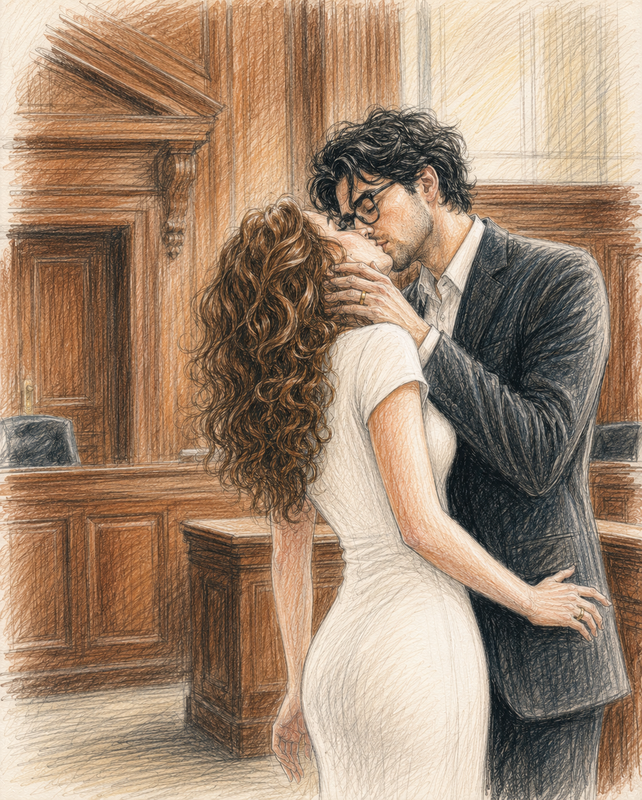
Harry wore the jacket he wore to most professional occasions. Hermione wore a white dress that she'd apparently bought in Chicago two years ago and never found occasion for. Ron and Draco were witnesses, which Ron had announced with a satisfaction that implied he'd been holding this role in reserve, and Draco stood next to the Registrar with the expression of a man who had been waiting for this particular event to occur for longer than was strictly necessary.
Teddy was there, sitting on Andromeda's lap in the second row, his hair cycling through three colours in rapid succession before settling, inexplicably, on gold. He was holding the enchanted caterpillar Hermione had sent him for his fourth birthday. He watched the proceedings with the seriousness of someone attending to something important.
The Registrar said the things Registrars said. They said the things that were required. And then there was a moment, in the quiet after the final declaration, where Harry looked at Hermione in the light of the Ministry courtroom with its dark panelling and its high windows, and thought about February and about all the years before February and about the years of Chicago and about the shower and about the green jacket and about the particular way her face held the light when she was thinking, and he thought: long enough.
He put his hand against her jaw, which was a thing he had been thinking about for longer than he would admit to her when they were alone, and she looked at him with something that was surprise and also, clearly, had been wanting the same thing, and he kissed her.
Her hands came up and she kissed him back, and somewhere behind them Teddy said "Ohhhhh" in a tone of significant discovery, and Ron laughed, and Draco said something quiet that was probably dry and almost certainly affectionate, and Harry kept his hand against her face and thought: on time for everything else.